
8 posts tagged with "playwright-test"

View All Tags

Serenity/JS 3.47: component testing with Playwright

· 4 min read

Serenity/JS 3.47 brings web UI component testing into the same Screenplay Pattern architecture as the rest of your suite. The new story fixture mounts a Playwright component story, and the newly introduced Question.as(Constructor) lets you turn it into an Interaction Object.

That means the interaction model you use to exercise the component in isolation can be the same one your end-to-end scenarios use when exercising the running application.

This release also introduces new guides to help you set up component testing and keep your web test code portable with Serenity/JS web modules.
Code was never the hard part

· 6 min read

Jan Graefe recently published an open letter in response to the updated Getting Started guides on serenity-js.org. His letter touches on something that's been central to the Screenplay Pattern since 2007 — and that I've been working on since joining the effort in 2013: the idea that test automation should express intent, not implementation.

I'd like to respond publicly because the ideas Graefe raises deserve a wider conversation.

Serenity/JS 3.32: Worker-scope actors and better reporting for Playwright Test

· 8 min read

The latest release, Serenity/JS 3.32, brings powerful enhancements to your test automation workflow. This version focuses on further improving the integration between Playwright Test and Serenity BDD, delivering rich, actionable test reports that go beyond pass/fail results.

Key updates in this release:

🎭 Improved APIs and support for using actors in beforeAll and afterAll hooks.

✅ Improved reporting, including support for retried tests, repeated tests, and project tags.

⚙ Configuration updates to better separate test-scope and worker-scope fixtures.

Let’s take a closer look at what’s new!

Support for @tags

· 2 min read

Support for tagging

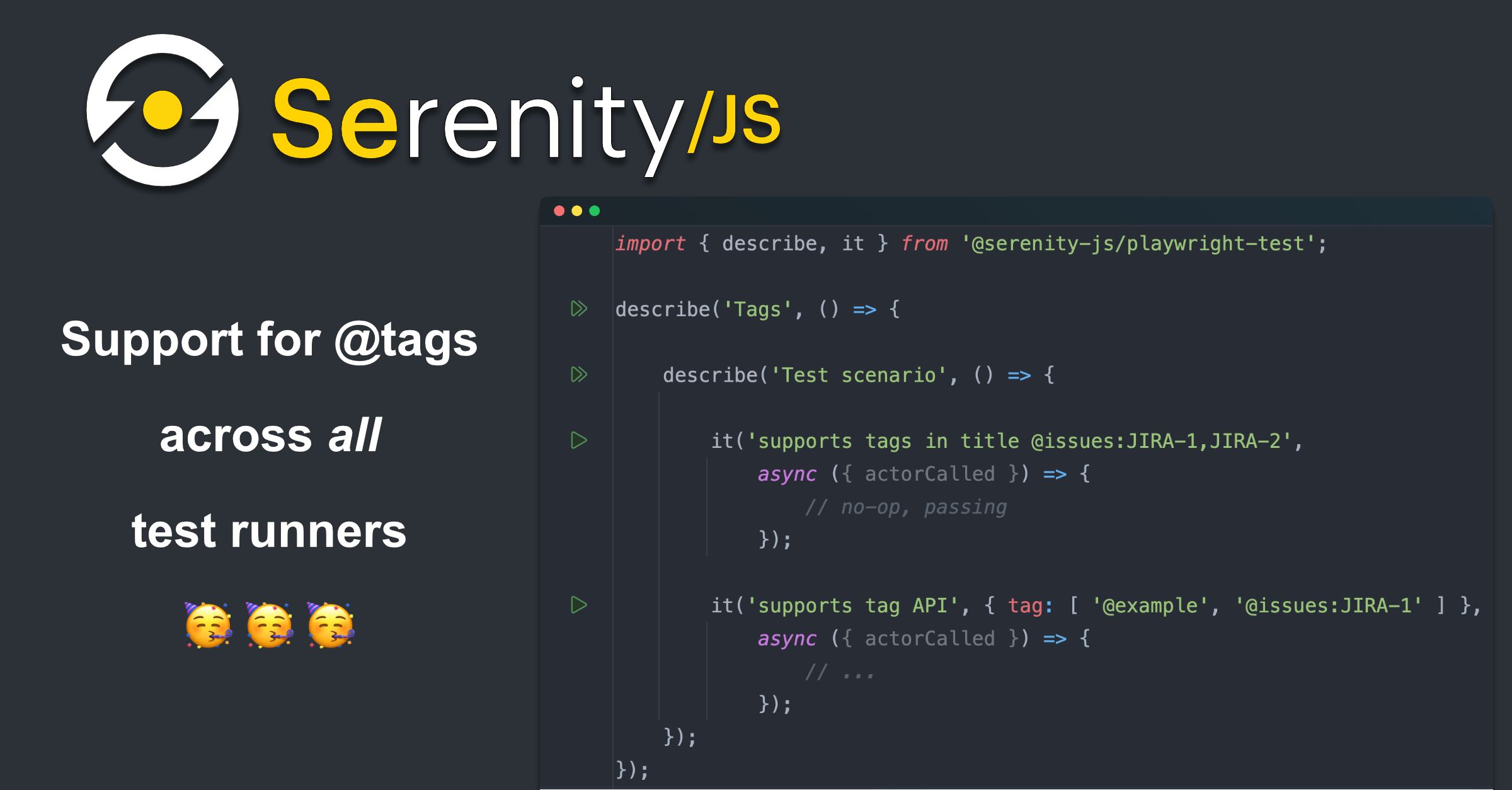
📣 Serenity/JS now supports tagging across all the test runners 🎉

With the new release of Serenity/JS 3.21, tagging test scenarios just got easier. Now, you can use @tags across all the supported test runners, so:

Why should you tag your scenarios?

Tagging test scenarios helps you organise and filter your test suites. You can categorise tests based on functionality, priority, or type, making it easier to manage and focus your testing efforts.

Plus, tagging allows for selective test execution. You can run a subset of tests by specifying relevant tags, which is handy for regression testing or when focusing on specific parts of your application.

Tagging also improves test reporting and integrates well with test management tools. It gives you insights into test coverage and helps streamline test planning and tracking.

And if you're using Playwright Test, Serenity/JS supports the latest Playwright 1.42 tag API, enhancing your tagging capabilities even further!

Contributor spotlight

A huge thank you to our Serenity/JS Contributors for their work on this release:

  • Otoniel Isidoro, who enabled tagging support for Playwright Test
  • Mateusz Kruk, who greatly improved Playwright Test global error handling

Enjoy Serenity!

Support for Serenity BDD 4

· One min read

Serenity/JS 3.15.0 introduces support for Serenity BDD 4 and aggregated test reports for Playwright Test, WebdriverIO, Mocha, Jasmine and Cucumber! 🥳

We've also updated the Serenity/JS Handbook to help you get the most out of the new Serenity/JS and Serenity BDD reporting features - check out:

Important changes

If you're still using the Serenity/JS 2-style syntax for registering the SerenityBDDReporter, you'll need to update your configuration file to use the Serenity/JS 3 convention:

- import { ArtifactArchiver } from '@serenity-js/core';
- import { SerenityBDDReporter } from '@serenity-js/serenity-bdd';

// ...
crew: [
- new SerenityBDDReporter(),
- ArtifactArchiver.storingArtifactsAt('./target/site/serenity'),
+ '@serenity-js/serenity-bdd',
+ [ '@serenity-js/core:ArtifactArchiver', {
+ outputDirectory: 'target/site/serenity'
+ } ],
]
// ...

Learn more about Configuring Serenity BDD Reporter.

Support for Playwright Test UI Mode!

· One min read

Playwright Logo

Serenity/JS 3.3.0 introduces support for Playwright Test UI Mode, improves support for Playwright trace viewer, and leverages Playwright auto-waiting locators! 🥳

Check out our new tutorial where in less than 5 minutes, you'll learn how to integrate Serenity/JS with your Playwright test suite, enable Serenity BDD reports, start using the Screenplay Pattern, and get started with Playwright Test UI Mode!

Learn about Using Serenity/JS with Playwright Test!